The best AI features might not look like AI
Recently, our team worked on a feature at Holidu that reminded me of something I think we sometimes overlook with AI: AI does not always need to become a big, visible feature to be useful for our users.
Sometimes, its most useful role can be much quieter: helping the product understand something it previously couldn’t.
The surprisingly complicated case of changing an address
Changing the address of a holiday rental might sound like a fairly simple task. But once a property is already published and distributed to several booking channels, an address change can require additional verification.
Some booking channels require a document confirming the new address before they will accept the change. In those cases, we ask the host to upload the document, and we send it to the relevant channels on their behalf.
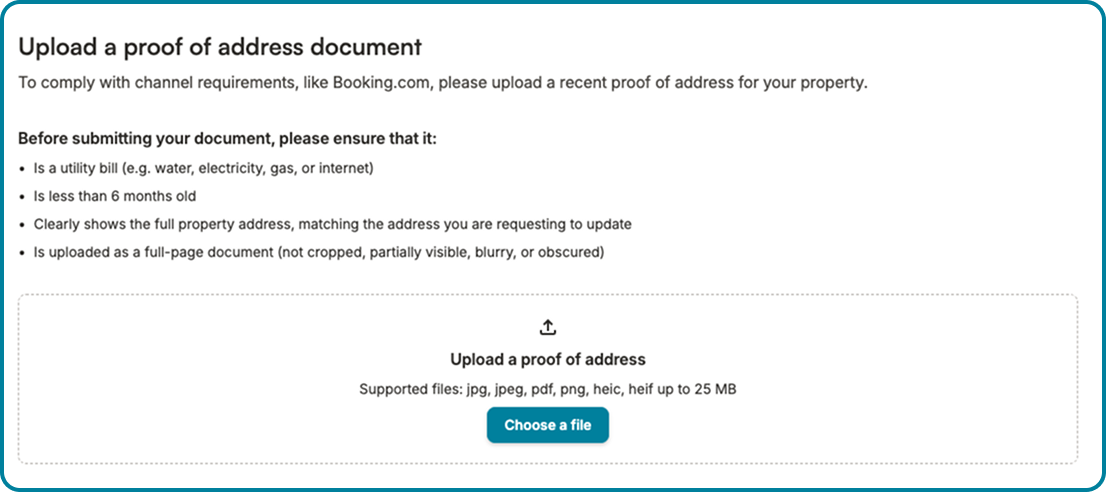
Of course, that document needs to meet certain criteria, so we explain those requirements in the interface. But even with these instructions, things can still go wrong: a bill might be too old, the document might be unreadable, or some of the information we need might simply be missing.
The product couldn’t tell when something was wrong
Until now, the product itself had no way of detecting these issues.
The host could upload the document and submit the request successfully. Only later, when our Customer Service team reviewed it, we would discover that something was wrong with the document.
That turns a relatively small mistake into a much longer process: someone has to review the document, identify the problem, contact the host, explain what needs to change, and wait for another document to be uploaded.
For the host, that means extra back and forth for something they thought they had already completed, and a longer wait before the address can be corrected. For our Customer Service team, it means additional manual work reviewing the issue, contacting the host, and processing a new document. And until that is resolved, the property will continue to show the wrong address on booking channels.
The obvious improvement would be to catch these problems before the host submits the document.
The problem was that, until relatively recently, giving a product the ability to actually understand the contents of an uploaded document would have required some heavy work. For such a narrow use case, that level of technical investment would have been difficult to justify.
And this is where AI changed the equation.
Catching problems before submission
Instead of waiting until Customer Service reviews the document, we can now, thanks to AI check it as soon as the host uploads it.
That check is based on the same criteria our team would otherwise review manually: Is it the right kind of utility bill? Is it recent enough? Is the full address visible? Is the document readable?
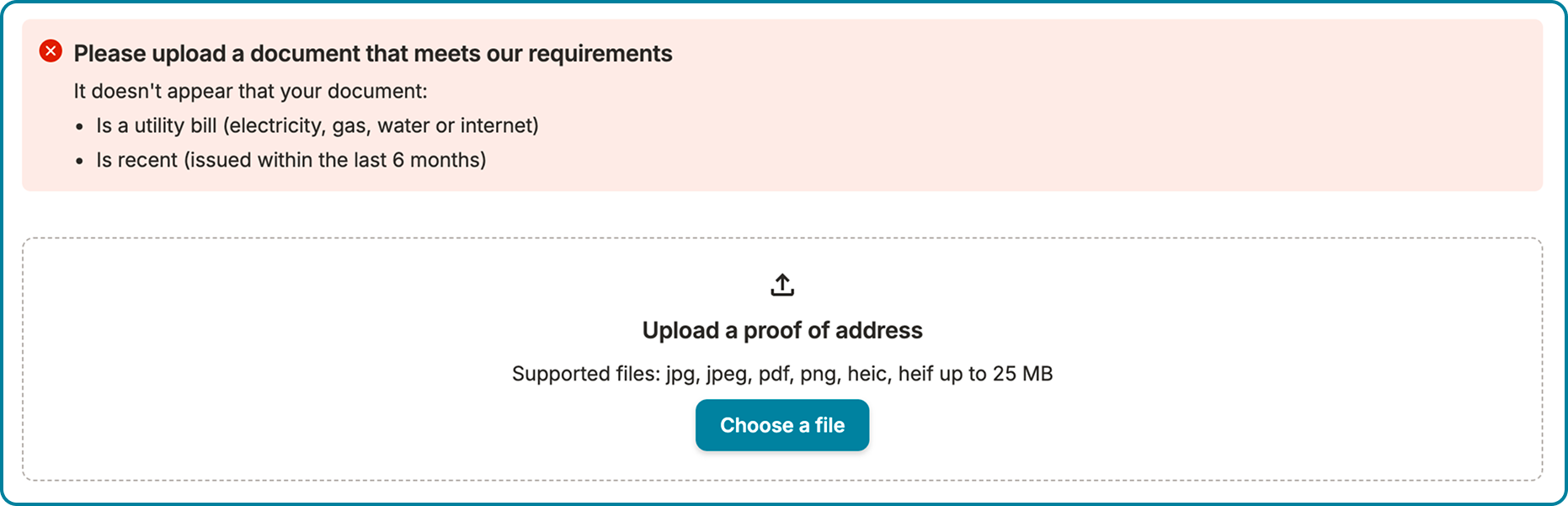
If everything looks good, the host can continue. If something is wrong, they get immediate feedback tailored to the exact issue and can fix it straight away.
From the host’s perspective, the interaction itself barely changes. They still upload a document and receive feedback if something is wrong. What changes is the product’s ability to understand what they uploaded and respond immediately.
After upload, the document is checked against each criterion and the host gets immediate feedback on what needs to be fixed to continue.
Of course, making this simple interaction possible requires a bit more work. Ketan, who worked on the backend implementation, explains it like this:
”Behind the scenes, we send the PDF or photo directly to the AI model, which reads and analyses the document.
It checks four criteria independently: the type of document, its date, whether the full address is visible, and whether the document is readable and contains all the required information.
For each of these checks, the model tells us whether it passed or failed. We then map any failed checks to messages we have already written and translated, so the AI identifies the issue while we keep control over what the host sees.
If the model cannot validate the document reliably, for example because it is unreadable or the validation fails for a technical reason, we do not assume it is valid. Instead, the host is asked to try again or upload another document.”
In the end what this means ? For hosts, this means fewer unnecessary back-and-forths, clearer feedback, and a faster path to getting their property live. For Holidu, it means fewer cases requiring manual intervention, less operational work, and a process that can scale without adding the same amount of human effort.
This is a relatively small use case, but it points to a broader question: where else could AI give a product a capability it did not have before?
From AI as an interface to AI as a capability
When I look at how AI is being applied in product design, I often see the most attention going to experiences where users explicitly interact with AI, such as assistants, copilots and agents.
That makes sense. ChatGPT and Claude showed how powerful conversation can be as an interface, and many products have followed that pattern, including Holidu.
These kinds of features are also very visible. They are easy to demonstrate, easy to position as innovation, and they make the role of AI obvious to users. From a product and marketing perspective, that is naturally attractive.
But AI can also become part of a product in a much quieter way.
The document validation example works differently. AI is not the interaction. It is a capability embedded inside an interaction that already existed. The host still uploads a document and receives validation feedback. AI simply gives the product a better way to understand what they uploaded.
I think this kind of use case is easy to overlook.
What does this mean for product builders?
For me, the takeaway is to look beyond new AI features and pay attention to the smaller moments where the product does not understand enough to guide or support the user well.
Maybe it is a document that would normally need to be reviewed manually. Maybe it is a property photo that contains something a booking channel might reject. Maybe it is a guest-arrival note that sounds complete, but could still leave a guest confused about how to find the property.
Those are the moments where I think it is worth asking:
Is there something here that the product cannot understand well enough today? Could AI help with that?
And if so:
How could that understanding make the experience better for the user?
In our case, that meant catching a problem before the host submitted the document. In another case, the outcome might be completely different.
AI is not the outcome
Ultimately, the interesting part is not the AI itself, but what it enables the product to do that it could not do before.
If AI can close a gap in what the product understands and make the experience better, it does not necessarily need to be visible at all. Sometimes, the best use of AI might simply be the one the user never notices.